Alpharetta and north Fulton County, Georgia
Mold Removal in Alpharetta: Damp Basements, Aging Plumbing and Humid Summers
Mold removal in Alpharetta is mostly a story about houses from one era. Well over half the city's homes went up in the 1980s and 1990s, many on sloping lots, and they are now old enough for water heaters, supply lines and basement finishes to give trouble. Summers thick with moisture do the rest.
Most mold removal in Alpharetta follows water: a finished basement that stays damp, a slow leak from a water heater or supply line, or condensation on cool surfaces in July. Fix the moisture, then remove what grew. This Old House (2026) puts a typical job at $1,200–$3,750; Fixr (2025) lists a basement at $1,500–$4,000.
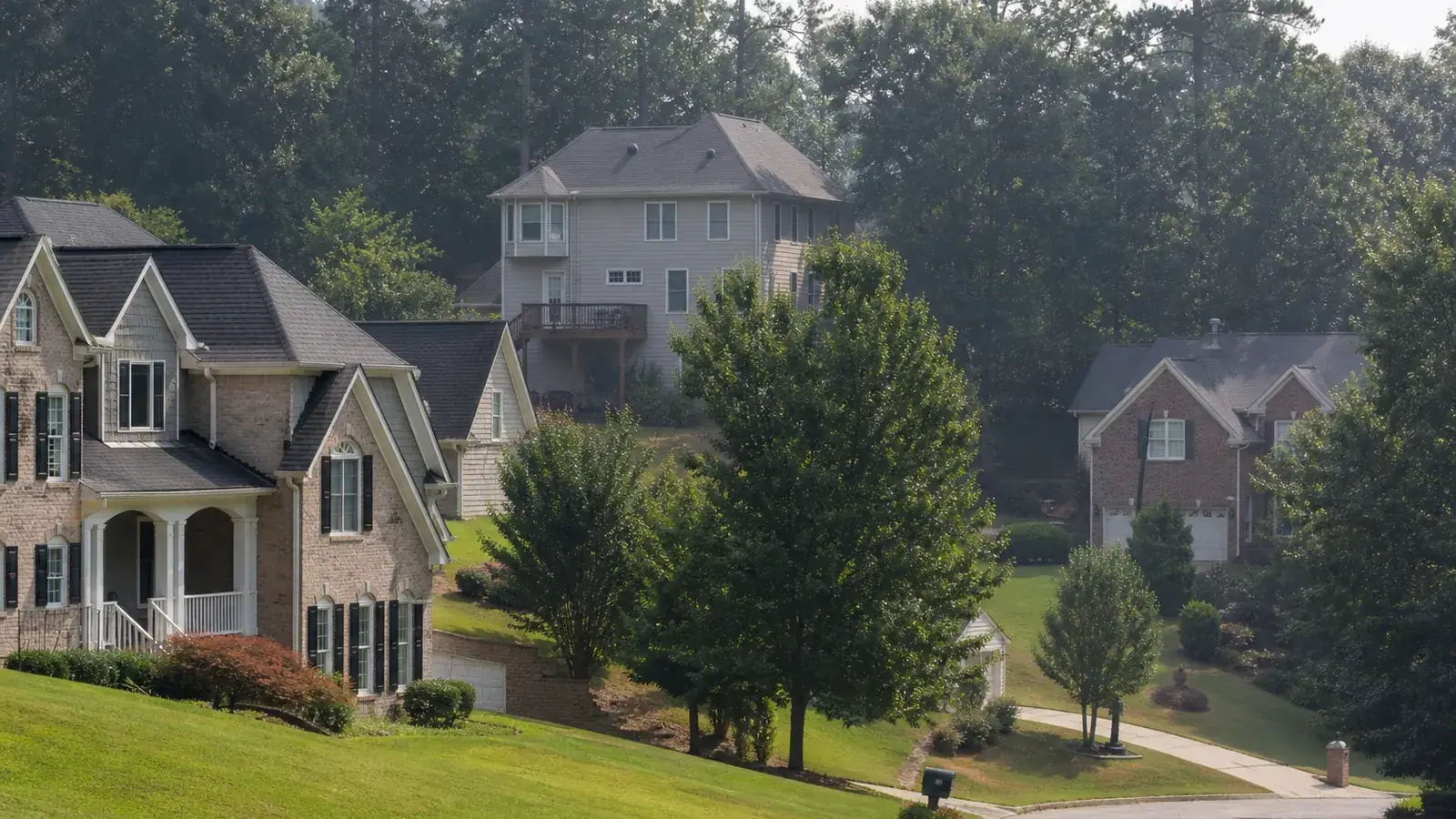
What mold removal in Alpharetta usually involves
Of Alpharetta's 26,223 homes, 14,837 were built between 1980 and 1999, and the 1990s alone account for 9,081, more than any other decade. The median home dates to 1996 (U.S. Census ACS 2020–2024). A house of that age has probably replaced its water heater at least once, its caulk and window seals are getting tired, and if it has a basement, there is a fair chance someone has finished it with drywall and carpet.
So a typical job here has three parts. Someone finds and stops the water. Wet or moldy porous material, usually drywall, insulation and carpet pad, is cut out and bagged behind plastic sheeting. Then the space is cleaned, dried and checked before anything is rebuilt. The EPA's rule of thumb applies to the small stuff: under about 10 square feet, most households can clean it themselves.
July is the hard month for Alpharetta houses
Air holds more water as it warms. At Atlanta's main airport, the average July dew point is about 68°F (NOAA hourly normals), which means any surface in a house cooler than that collects water the way a cold glass does. Below-grade basement walls, supply ducts in a crawl space or attic, and cold water pipes all qualify. The EPA's target indoors is relative humidity below 60 percent, ideally 30 to 50.
Rain is steady rather than seasonal here. Atlanta Peachtree Airport, the closest normals station, averages 51.4 inches a year, with 77 days bringing at least a tenth of an inch and no month averaging under 3.39 inches (NOAA 1991–2020). Gutters and grading get a workout all year.
Mold problems Alpharetta houses have most
- Basement mold in AlpharettaHillside basements, summer condensation, finished walls and carpet, and what fixes it for good.
- Mold after a leakWater heaters, supply lines, dishwashers and roofs: the first 48 hours, what to keep, and insurance.
- Mold inspection and testingWhen an inspection helps, when lab samples are worth the fee, and buying or selling a 1990s house.
- Mold removal cost in AlpharettaRoom-by-room ranges, basements, leaks and the rebuild, from This Old House, Fixr and HomeGuide with dates.
Background worth five minutes
- Mold signs through an Alpharetta yearWhat a musty basement in July, foggy windows in January or a stained ceiling in spring usually means.
- Alpharetta's 1980s and 1990s houses and moistureWhat the census says about the city's housing, and the places houses of that era hold water.
Basements, slopes and Big Creek
Federal soil maps put much of Alpharetta on well-drained Piedmont soils such as Cecil and Madison, with many lots on slopes of 10 percent or more (USDA NRCS). That is good for drainage overall, but a basement dug into a hillside has earth against the uphill wall and daylight on the downhill side, and the uphill wall is where seepage and musty carpet usually start. See basement mold in Alpharetta.
Along Big Creek the soils are mapped as flood-prone. The USGS gauge near Alpharetta has recorded its highest flow on February 3, 1982, at 6,100 cubic feet per second, and the September 21, 2009 flood ranks fourth at 5,200 (USGS).
Georgia has no mold standard: how to judge a company
The Georgia Department of Public Health says plainly that mold inspection, testing and remediation have no enforceable state or federal standards, and that indoor air quality is not a regulated program. No state agency inspects private homes for mold. That leaves the homeowner to judge the work. Ask how the company finds and confirms the moisture source, how it contains the work area, what comes out and what is only cleaned, and how it checks the result before the walls go back. Ask, too, for a written scope and the warranty terms before you sign.
How this site passes on your request
Alpharetta Mold Fix writes about mold and moisture in local houses; it does not inspect, test or remove anything. When you send the form, one independent mold specialist who serves Alpharetta gets it, and that specialist pays the site for the referral. There is no charge to you for asking, and nothing stops you from getting other opinions.
Questions homeowners ask
Why does my Alpharetta basement smell musty every summer?
Warm, humid outdoor air meets cool basement walls and floors, and moisture condenses where you cannot see it, often under carpet or behind drywall. July dew points near Atlanta average about 68°F (NOAA). A dehumidifier holding the basement below 60 percent relative humidity, per the EPA, usually ends the smell if no water is coming in.
Does Georgia regulate mold removal companies?
Not with any mold-specific rule. The Georgia Department of Public Health says mold inspection, testing and remediation have no enforceable state or federal standards. That puts more weight on your own questions: how the moisture source will be fixed, how the work area is contained, and how the company checks the result.
Is bleach enough for mold on basement drywall?
No. The EPA does not recommend bleach as a routine cleanup step, and it cannot reach growth inside drywall paper or behind it. Drywall and carpet pad with mold growing in them are cut out and replaced once the moisture is fixed; hard surfaces are scrubbed and dried.
Tell the specialist what you found
Mention the room or level, whether it is a finished basement, and what got wet: a water heater, a supply line, rain at a wall, or nothing you know of. If you are buying or selling, say so. An independent mold specialist serving Alpharetta receives it and replies to you.